How to Move to Dubai – The Full Guide by Sally Filo
October 20, 2026
A local’s inside look at relocating to Dubai in 2026. Explore neighborhood prices, family living costs, schooling, and how buying a home unlocks long-term residency.
How to Move to Dubai – The Full Guide by a Local (by Sally Filo)
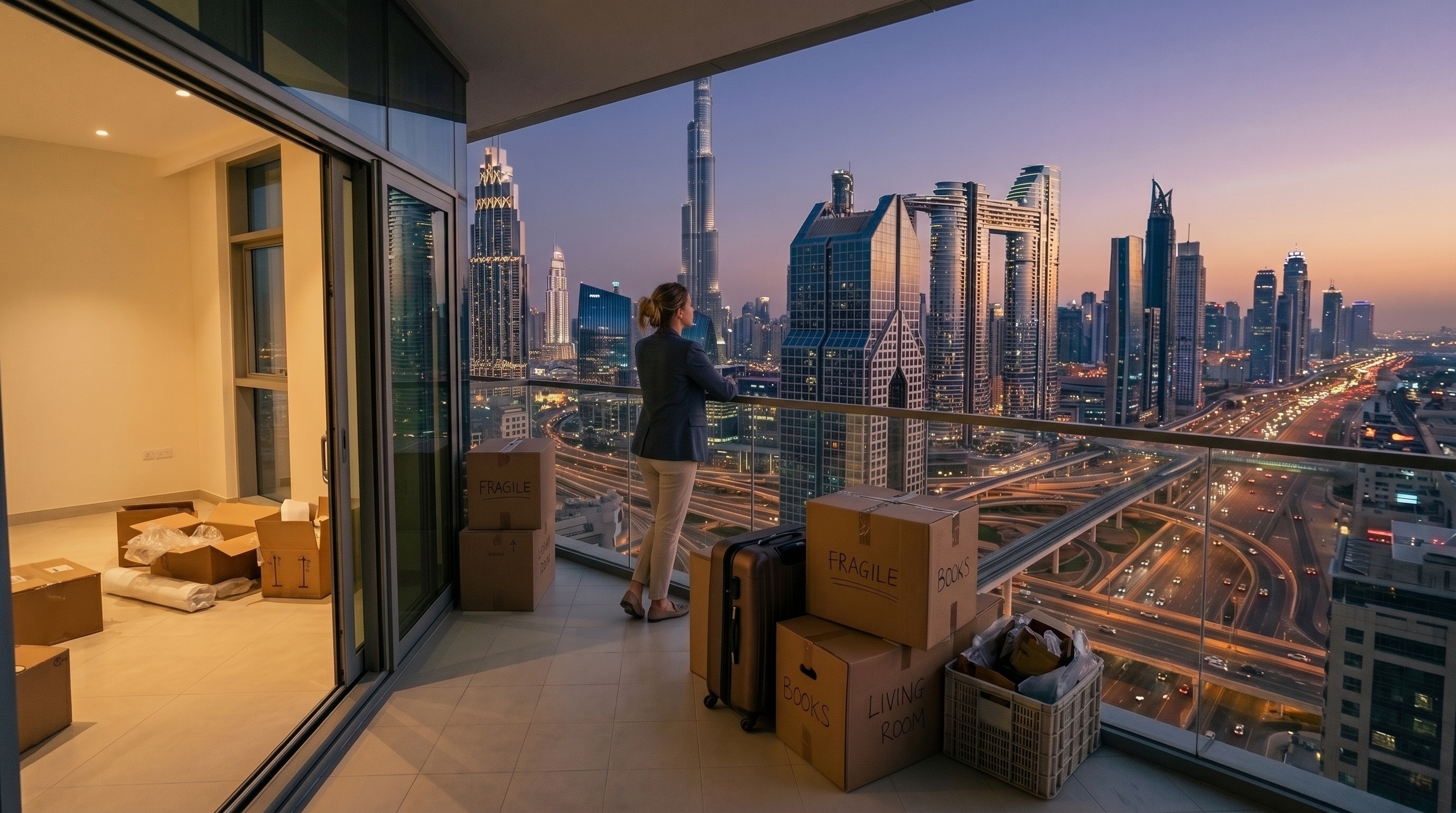
I arrived in Dubai in the summer of 2014 with a job offer and two suitcases. The flight landed after dark, yet the air outside still felt warm even at that hour.
The first days were spent moving between a hotel and a series of viewings, learning how deposits and utility connections worked, and getting used to a city that runs on air-conditioned cars and carefully timed outdoor plans.
What I noticed early on was how quickly the practical pieces fall into place once you have a place to stay and a clear next step for residency.
Twelve years later the skyline has grown and new communities have appeared, but the core questions people ask when they first arrive remain similar: how long can I stay while I look around, where do families settle, what does a realistic monthly budget look like, and how does buying a home connect to longer-term residency.
This is the picture as it stands in 2026, drawn from both my own experience and the patterns I have seen with other families.
Arriving and getting time to look around
Most European passport holders can enter the UAE without applying for a visa beforehand. Citizens of EU member states, the United Kingdom, and a long list of other European countries receive a stamp on arrival that permits a stay of up to 90 days.
For many Schengen-area nationals the arrangement is framed as 90 days within any 180-day period, and Dubai’s residency authority provides an online calculator so people can track remaining days if they make more than one trip.
That window is useful for a reconnaissance visit, for people whose job offer is already in place, or for those who simply want to walk through a few communities before committing.
Once the stamp period ends, the usual paths are to leave and re-enter later, to apply for an extension where it is available, or to move into a formal residency visa.
The process of switching from a visit stamp into residency is routine once an employment contract, property ownership, or other qualifying basis is confirmed.
In practice, many Europeans use the first few weeks or months to open a local bank account, visit schools if they have children, and shortlist areas before finalising longer-term paperwork.
Residency routes that support a longer stay
Employment sponsorship remains the most common starting point for people who arrive with a job. Once the company processes the visa, you complete a medical fitness test, obtain health insurance, and receive an Emirates ID. From there you can sponsor a spouse and children.
Property ownership offers two well-established alternatives. The Golden Visa through real estate is available when the purchase value of one or more properties registered in your name reaches AED 2 million (approximately USD 545,000 or GBP 407,000).
Ready properties, mortgaged properties accompanied by a bank no-objection letter, and off-plan units from approved developers can all qualify under current Dubai Land Department practice.
Applications are submitted in person inside the UAE, and processing often completes within 7–10 business days once the required documents and medical results are in order.
Government fees for the principal applicant are in the region of AED 9,900 (roughly USD 2,700 or GBP 2,010). Spouse, children, and in many cases parents can be sponsored on the same permit, which is renewable.
A more accessible option is the two-year investor visa handled through the Dubai Land Department’s Taskeen service.
Since April 2026 a sole owner of a completed residential property that already has a title deed can apply with no minimum purchase value.
Where the property is held jointly, each co-owner’s share needs to be at least AED 400,000 (around USD 109,000 or GBP 81,400). Off-plan units do not qualify until the final title deed is issued.
Fees for the principal applicant sit near AED 10,200. The visa is renewable provided ownership continues.
Both property routes allow you to live and work without an employer sponsor once the residency is issued, which many people find helpful once they have settled.
Choosing a neighbourhood and what homes cost
Most families eventually settle in one of the established villa or townhouse communities rather than the denser central districts.
The choice usually comes down to school proximity, the length of the school run, the amount of outdoor space, and the monthly rent or purchase price.
The ranges below reflect typical 2026 asking and registered figures for three-bedroom family homes; exact prices move with the specific building, view, and condition.
Many people rent for the first year or two. That period gives time to understand traffic patterns, school bus routes, and which supermarkets fit daily shopping habits before deciding whether to buy.
Rental contracts are normally annual, with cheques or bank transfers as the usual payment method, and a housing fee of 5 % of the annual rent appears on the utility bill.
A realistic monthly budget for a family of four
Housing and school fees form the largest parts of most family budgets.
In 2026 a comfortable mid-range lifestyle for two adults and two school-age children typically falls between AED 35,000 and AED 55,000 per month (approximately USD 9,500–15,000 or GBP 7,100–11,200), depending on the community and the curriculum chosen.
A more modest arrangement is possible; a villa in a premium community with higher-tier schools sits higher.
Here is a practical monthly outline for a mid-range setup:
Rent for a three-bedroom apartment or townhouse in a community such as JVC or Mirdif: AED 11,000–16,000 (USD 3,000–4,350 / GBP 2,240–3,250)
School fees for two children at a mid-tier British or equivalent curriculum: AED 6,000–10,000 (USD 1,630–2,725 / GBP 1,220–2,030)
Annual fees commonly range from AED 35,000 to AED 70,000 per child.
Groceries and household items: AED 3,500–5,000 (USD 950–1,360 / GBP 710–1,020)
Utilities, housing fee, internet and mobile: AED 1,800–2,600 (USD 490–710 / GBP 370–530)
Transport (fuel, Salik tolls, insurance for one or two cars): AED 1,500–2,800 (USD 410–760 / GBP 305–570)
Health insurance top-up for dependants: AED 800–1,800 (USD 220–490 / GBP 160–370)
Dining out, activities and miscellaneous: AED 2,500–4,500 (USD 680–1,225 / GBP 510–915)
There is no personal income tax in the UAE, which simplifies the calculation once rent and school fees are known.
Grocery costs stay manageable at larger hypermarkets such as Carrefour, Lulu or Union Coop; speciality stores are available for imported items.
Most families find that once the school and housing decisions are made, the remaining categories become easier to plan.
Buying a home
Foreign buyers can purchase freehold property in designated areas with no restriction by nationality.
The main one-time costs on a ready property are the 4 % Dubai Land Department transfer fee, agency commission (commonly 2 % plus VAT on resales), trustee registration fees, and title-deed issuance.
Altogether these typically add roughly 6–7 % to the purchase price for a cash resale.
Off-plan purchases often involve lower buyer-side commissions because the developer covers the agent fee. There is no annual property tax.
A cash purchase of a completed unit can usually be completed within a few weeks after the price is agreed and the seller obtains the developer’s no-objection certificate.
Mortgage purchases take longer and require income documentation.
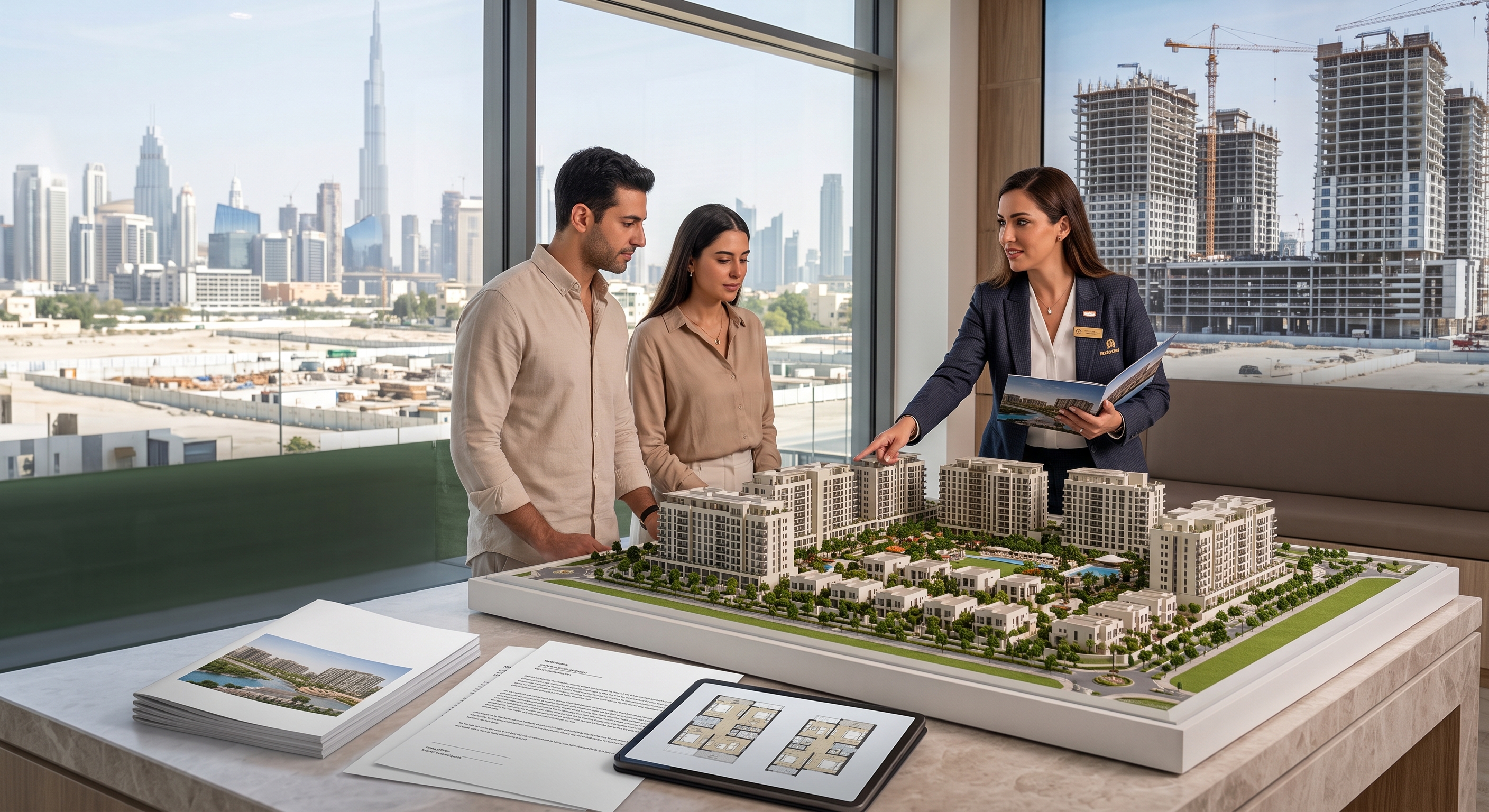
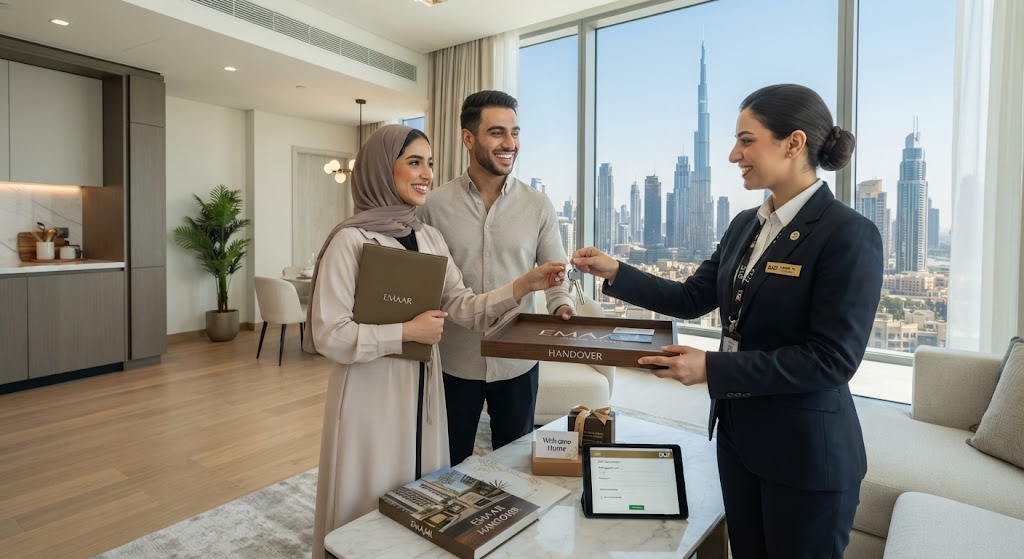
Many buyers begin with an off-plan unit that offers staged payments and a lower initial outlay, then take possession at handover.
Others prefer to rent first, learn the city, and then buy a ready home once they know the neighbourhood that suits daily life.
Service charges apply after handover and vary by community; they cover maintenance of common areas, landscaping and shared facilities.
Schools, healthcare and everyday rhythms
Private schools cover British, American, IB, Indian and other curricula, and fees are regulated by the Knowledge and Human Development Authority.
Places at well-regarded schools are allocated well in advance, so families often begin applications once they have a shortlist of communities.
Many communities have schools inside or immediately adjacent, which shortens the morning run.
Healthcare is largely private and insurance-based. Employer plans usually cover the employee comprehensively; dependants often require an additional policy. Clinics and hospitals are well distributed, and routine care is straightforward once insurance is in place.
Daily life settles into a pattern shaped by the climate.
From late spring through early autumn, outdoor activity moves to early mornings and evenings, while malls, indoor play areas and community pools become the main daytime options.
Winter months are milder and more people spend time in parks and on the beach.
Most family communities are designed around cars, so a vehicle becomes part of the routine for school runs and shopping; metro access is convenient in central districts but less so in the villa areas.
Safety levels are high, English is widely spoken, and the large international population means most newcomers find familiar products and services within a short time.
Putting the pieces together
The first months usually involve securing temporary accommodation, completing the residency medical and Emirates ID steps, opening a bank account, and confirming school places if children are involved.
Many people find that renting for the initial period gives useful time to compare communities before committing to a purchase.
Once residency is in place, the practical tasks become simpler, and attention can shift to longer-term decisions such as buying a home that also supports a Golden Visa or the two-year investor route.
Dubai has expanded considerably since 2014, with new family communities, improved roads, and clearer residency pathways linked to property ownership.
The 90-day entry window gives Europeans a practical opportunity to visit, view homes, and begin the residency process.
From there the combination of a suitable neighbourhood, a realistic budget that accounts for school fees, and a clear residency route allows most families to settle into a steady rhythm.
If you are mapping out a move and would like help identifying properties that fit a particular budget and residency timeline, our team works with families on exactly that process — shortlisting communities, reviewing current options, and guiding the purchase and visa steps.
A free consultation by phone or Zoom is available so we can talk through your specific situation and the practical next steps.